

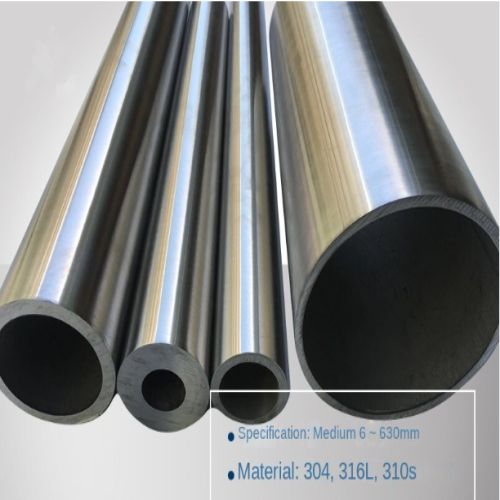
We can offer Stainless Steel Pipe products, including Stainless Steel Capillary Pipe, Stainless Steel Precision Pipe, Stainless Steel Seamless Pipe, Stainless Steel Sanitary Pipe, Thick Wall Stainless Steel Pipe, Stainless Steel Bright Tube, Stainless Steel Needle Tube, Stainless Steel Fine Tube, Stainless Steel Coil, Welded Stainless Steel Pipe, Stainless Steel Industrial Pipe, Stainless Steel Round Tube, Medical Stainless Steel Tube, Stainless Steel Thin Wall Tube, Stainless Steel Shaped Tube, Stainless Steel Elbow, Stainless Steel Snake Bone Tube, Stainless Steel Decorative Tube, Stainless Steel Electronic Cigarette Tube, Stainless Steel Tube Processing, Copper Pipe, Titanium Alloy Tube, Aluminum Tube, and so on.
The development of the global stainless steel industry has gone through hundreds of years and has gone through about three stages:
1. From the beginning of the 20th century to the 1950s is the initial stage
Germany, Britain, the United States and other countries have successfully developed martensitic, ferritic and austenitic stainless steels at almost the same time. After about 40 years of development, in the early 1950s, the global stainless steel production was about 1 million tons. At this stage, the application of stainless steel is mainly in some fields with special requirements for corrosion resistance and high temperature resistance.
2. The development stage from the 1950s to the mid-1980s
In 1950, the US stainless steel industry took the lead in realizing civilian use, and the stainless steel production gradually achieved accelerated development. After another 40 years of development, by 1990, the global stainless steel production exceeded 10 million tons. During this period, the stainless steel smelting technology, continuous casting technology and multi-roll cold rolling mill technology represented by out-of-furnace refining were successfully developed successively, which promoted the scale development of global stainless steel. At this stage, stainless steel began to enter the homes of ordinary people, and the civilian level began to gradually expand.
3. From the mid-1980s to the present, it has experienced rapid development to a stage of slowing growth
1990-2000 market expansion period; 2000-2016 accelerated development stage; 2016-present, growth slowdown stage
Since the 1990s, the development of the stainless steel industry has broken through traditional markets such as Europe, America and Japan, and has begun to develop into a broader emerging market. In the 1990s, the first large-scale main production area in the history of the global stainless steel industry, the European stainless steel market, was born. After more than ten years of development, by 2002, the global stainless steel output exceeded 20 million tons.
Entering the 21st century, the global stainless steel industry has further accelerated its development. The production and consumption of stainless steel in developing countries continue to grow, especially the rapid economic development of China and other Asia-Pacific countries, as well as the increase in consumption in the civilian sector, driving the rapid growth of global stainless steel production. However, during the global financial crisis in 2008, the production of stainless steel experienced negative growth for two years. From 2010 to 2016, the growth rate of global crude steel production maintained double-digit growth, and China played a leading role.
Since 2017, the growth rate has slowed down year by year. In 2019, the global output of crude stainless steel reached 52.218 million tons, but the annual growth rate slowed to 2.94%. The global spread of the new crown epidemic in 2020 has brought great challenges to the normal operation of the stainless steel industry. Global stainless crude steel production fell to 50.892 million tons, down 2.5% year-on-year.
2. The proportion of China's stainless steel in global crude steel production has gradually increased
The development of stainless steel in China has roughly gone through four stages:
1. Before 1980 (1952-1979) is the initial stage
My country has established some special steel enterprises mainly by learning from the Soviet Union. At this stage, the demand for stainless steel is mainly for advanced use in industry and defense, and the annual output of stainless steel is very small.
2. From 1980 to 1999, it entered a stage of rapid development
The focus of the country's work has shifted to modernization. By 1999, the apparent consumption had increased significantly to 1.53 million tons, and the output was still only 300,000 tons.
3. From 2000 to 2007, it began to enter the stage of technological change
With the rapid development of the national economy and the continuous improvement of people's living standards, the demand for stainless steel has grown rapidly, and the large-scale use of domestic nickel pig iron has greatly reduced the cost of stainless steel in China. At this stage, the apparent consumption of stainless steel exceeded 5 million tons, and in 2007 it reached more than 6.5 million tons.
4. From 2008 to now, it has entered the stage of adjustment and transformation
In 2008, due to the impact of the financial crisis, the demand for stainless steel at home and abroad was weakened, and the apparent consumption of stainless steel in my country showed a negative growth year-on-year. By 2010, the export volume of stainless steel exceeded the import volume for the first time, with a net export volume of 470,000 tons, realizing the transition from a net importer of stainless steel to a net exporter.
Since 2010, China's crude stainless steel production has maintained a relatively stable growth, and its proportion in global stainless steel production has continued to increase. From the perspective of global production, from 2010 to 2020, the increase in supply mainly came from my country. As of 2020, my country's crude stainless steel production accounts for 59% of global production.
At the same time, private steel mills represented by Tsingshan and Delong have risen rapidly, and have successively built ferronickel production lines in Indonesia. With the substantial reduction in cost, China's voice in the international market has increased, and both production and consumption have remained stable. run high.