

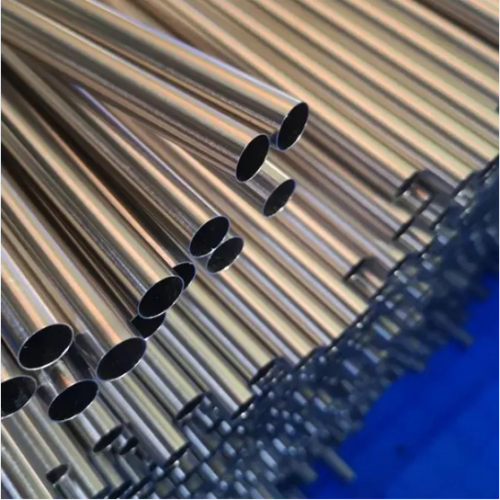
The invention and use of stainless steel can be traced back to the First World War. British scientist Henry Brearley was commissioned by the British government's military arsenal to study the improvement of weapons. At that time, the rifle chambers used by soldiers were extremely wear-and-tear, and Brearley wanted to invent an alloy steel that was not easy to wear.
The stainless steel invented by Brearley obtained the British patent in 1916 and started mass production. Since then, the stainless steel accidentally discovered from the garbage heap has swept the world, and Henry Brearley is also known as the "father of stainless steel". During the First World War, British guns on the battlefield were always transported back to the rear due to wear and tear. The military production department ordered Brearley, which developed high-strength wear-resistant alloy steel, to specialize in solving the wear problem of the gun chamber. Brearley and his assistants collected various types of steel and alloy steels produced at home and abroad, conducted performance experiments on various types of machinery, and then selected the most suitable steel to make guns. One day, they experimented with a domestic alloy steel containing a lot of chromium. After a wear resistance test, it was found that the alloy was not wear-resistant, indicating that it could not make guns. So they recorded the experimental results and threw them in the corner. thing.
One day a few months later, an assistant rushed to Brearley with a piece of shiny steel and said, "Sir, this is the alloy steel sent by Mr. Mullah I found when I was cleaning the warehouse. You Do you want to experiment to see what special effect it has!" "Okay!" Brearley said happily, looking at the bright and dazzling steel.
The experimental results show that it is a stainless steel that is not afraid of acid, alkali and salt. This stainless steel was invented by Mullah in Germany in 1912. However, Mullah did not know what this stainless steel was used for.
Brierley thought in his mind: "This kind of steel that is not wear-resistant but corrosion-resistant can't be used to make guns. Can it be used to make tableware?" He went ahead and made a stainless steel fruit knife, fork, spoon, fruit plate and folding knives.
Nowadays, the application fields of stainless steel are getting wider and wider, and the demand is also increasing, so let's talk about those things about stainless steel.
First of all, let`s talk about the classification of stainless steel: stainless steel is divided into chromium stainless steel, chromium-nickel stainless steel and chromium-manganese-nitrogen stainless steel according to the main chemical composition.
Let's talk about the advantages of 304 stainless steel: (1) Environmental protection and hygiene: eliminate the problems of red water, blue-green water, and hidden water, no peculiar smell, no precipitation of harmful substances to keep the water pure, lead-free and harmless to human health. (2) Wear resistance: The surface is beautiful, clean, bright, durable, scratch-free, never rusted, never broken. 3. Low temperature resistance: stainless steel water pipes and faucet angle valves in kitchen and bathroom will never break. (3) Excellent thermal expansion performance and thermal insulation performance: stainless steel pipe has slow thermal expansion and cold contraction, and good thermal insulation performance. (4) Authoritative certification: The precipitation of stainless steel metal elements is lower than 5% of the standard value specified by WHO and the European Drinking Water Act.
Stainless steel is generally divided into plates, long products and profiles according to the different shapes of the products after calendering. Stainless steel is often divided into: martensitic steel, ferritic steel, austenitic steel, etc.
From the analysis of stainless steel application industry, the automotive industry is currently the fastest growing stainless steel application field. In the past ten years, the consumption of stainless steel for automobiles in Japan has increased from an average of 10 kg to 30 kg, and the consumption in the United States has exceeded 40 kg. Buses, subways, high-speed railway vehicles and other public transportation vehicles also widely use stainless steel. China's home appliance industry is a potentially large market for stainless steel applications.
In the home appliance industry, the most used stainless steel is the inner drum of the automatic washing machine, the inner tank of the water heater, the inner and outer shells of the microwave oven, and the inner lining of the refrigerator, and ferritic stainless steel is mostly used. The proportion of stainless steel in household appliances in Western Europe is relatively large, and in Asia, except for Japan, which is close to the European level, it is generally used less. In 1999, the consumption of ferritic and martensitic stainless steels in Japan's home appliance industry reached 28%, and austenite accounted for 12%. Microwave ovens, refrigerators, air conditioners, TVs, etc. produced in my country are already competitive export products in the world, and the domestic home appliance industry is a potential big market for stainless steel applications. It is estimated that in the next 5-10 years, the demand for stainless steel in my country's home appliance industry will reach 100,000-150,000 tons.
We can offer Stainless Steel Pipe products, including Stainless Steel Capillary Pipe, Stainless Steel Precision Pipe, Stainless Steel Seamless Pipe, Stainless Steel Sanitary Pipe, Thick Wall Stainless Steel Pipe, Stainless Steel Bright Tube, Stainless Steel Needle Tube, Stainless Steel Fine Tube, Stainless Steel Coil, Welded Stainless Steel Pipe, Stainless Steel Industrial Pipe, Stainless Steel Round Tube, Medical Stainless Steel Tube, Stainless Steel Thin Wall Tube, Stainless Steel Shaped Tube, Stainless Steel Elbow, Stainless Steel Snake Bone Tube, Stainless Steel Decorative Tube, Stainless Steel Electronic Cigarette Tube, Stainless Steel Tube Processing, Copper Pipe, Titanium Alloy Tube, Aluminum Tube, and so on.